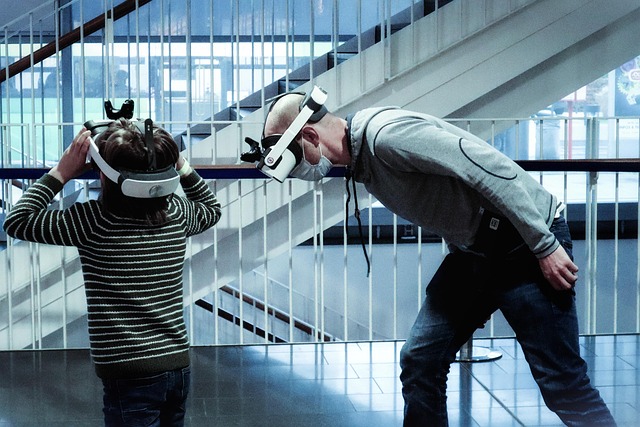

The convergence of immersive technologies and traditional sports has opened a new chapter for enthusiasts and developers alike. In this chapter, we examine how virtual reality (VR) is redefining the experience of golf, blending it with augmented reality (AR) and the broader metaverse ecosystem. By immersing players in lifelike environments and enabling real-time interaction across digital platforms, VR golf is poised to become a cornerstone of next‑generation gaming.
Historical Roots of Virtual Golf
Golf has long been a symbol of precision, strategy, and environmental immersion. The first forays into digital golf began with simple pixelated courses in the 1980s, progressing to fully 3D simulations in the 1990s. However, the leap from a screen to a headset marked a fundamental shift. VR golf introduced depth perception, spatial audio, and a first‑person perspective that made the virtual ball’s flight feel tangible.
- Early experiments: “The Golf Club” and “PGA Tour 2000” introduced basic 3D graphics.
- Mid‑2000s: “Virtual Golf” and “VR Golf” leveraged head‑mounted displays to create a more immersive swing experience.
- Recent breakthroughs: Haptic gloves and full‑body tracking allow users to feel wind resistance and ball impact.
The Mechanics of Immersion
What makes VR golf stand out is its ability to simulate not only visual fidelity but also the physics of the sport. The following components work together to deliver a compelling experience:
- Realistic Rendering: High‑resolution textures and dynamic lighting mimic the changing conditions of an actual golf course.
- Motion Tracking: Sensors capture arm movement, torso rotation, and foot placement to translate swings into the virtual environment.
- Audio Feedback: Spatial soundscapes react to the ball’s trajectory, providing cues about wind, distance, and club selection.
- Environmental Interaction: Trees, water hazards, and terrain deform in response to shots, giving players a sense of influence over the course.
Augmented Reality: Bridging the Physical and Digital
While VR transports players to entirely virtual worlds, augmented reality (AR) overlays digital elements onto the real world. In the context of VR golf, AR can serve several roles:
“AR can transform a simple backyard swing into a full‑featured golf experience, allowing players to practice their stroke while staying in their familiar surroundings.” — Game Tech Analyst
Examples of AR integration include:
- Smart mirrors that display swing metrics on the player’s reflection.
- Heads‑up displays (HUDs) that project club recommendations directly onto the real‑world view.
- Interactive golf simulators that track ball flight and provide instant feedback without leaving the physical space.
The Metaverse Connection
The metaverse represents a persistent, shared virtual space where users can interact, play, and build. VR golf is increasingly becoming a social activity within this ecosystem, offering features that go beyond traditional single‑player experiences.
- Shared Courses: Players can invite friends to join the same virtual course in real time, irrespective of their physical location.
- Customization: Avatars, golf clubs, and course modifications can be designed collaboratively.
- Economics: In‑game currencies and NFTs enable ownership of unique clubs, skins, or even custom holes.
Social Dynamics in VR Golf
Beyond the game mechanics, VR golf facilitates new forms of social interaction. Players can:
- Host virtual tournaments with leaderboards that span the metaverse.
- Record and share their best shots on social platforms that support 3D media.
- Collaborate on designing new courses, bringing together artists, engineers, and golfers.
Hardware Evolution and Accessibility
For VR golf to reach mainstream adoption, the underlying hardware must become more affordable and user‑friendly. Recent trends include:
- Lightweight headsets with high refresh rates to reduce motion sickness.
- Wireless controllers that free players from cumbersome cables.
- Open‑source SDKs that lower the barrier for indie developers to create immersive golf experiences.
Moreover, cloud streaming services allow high‑end VR content to run on modest devices, widening the potential audience.
Training and Professional Development
VR golf isn’t just entertainment; it’s also a valuable training tool for professional golfers and coaches. The immersive environment allows for:
- Precise swing analysis using motion capture.
- Scenario simulation, such as playing under different weather conditions.
- Stress‑management drills where players practice mental focus in controlled virtual settings.
These capabilities can accelerate skill development and provide data-driven insights that traditional coaching methods might miss.
Case Studies in Competitive Training
Several national teams have integrated VR golf into their regimens. For instance, the U.S. National Golf Academy used a VR platform to analyze 1,200 swings over a six‑month period, uncovering patterns that led to a measurable improvement in players’ driving accuracy.
Economic Opportunities and Challenges
The emergence of VR golf has spurred a new set of business models. Subscription services, micro‑transactions for cosmetic items, and platform‑specific marketplaces create diverse revenue streams. However, developers face challenges such as:
- Ensuring consistent performance across a range of hardware configurations.
- Balancing realism with playability to keep casual gamers engaged.
- Managing intellectual property concerns when real‑world courses are replicated in digital form.
Future Horizons
Looking ahead, several innovations could reshape VR golf:
- Brain‑computer interfaces that translate thoughts into swing decisions.
- Haptic suits that simulate wind, gravity, and terrain resistance with unprecedented fidelity.
- Cross‑platform play that unifies VR, AR, and traditional console experiences into a seamless ecosystem.
These possibilities suggest that VR golf is not merely a niche product but a foundational pillar of immersive sports entertainment.
Closing Reflections
From its humble pixelated beginnings to today’s hyper‑realistic simulations, VR golf exemplifies how technology can deepen our engagement with classic sports. By merging virtual reality, augmented reality, and the evolving metaverse, it offers a future where players can practice, compete, and socialize in ways that transcend physical boundaries. The ongoing evolution of hardware, software, and community culture will determine how deeply VR golf is woven into the fabric of gaming and beyond.